
A diagonal beam of white light passes through a transparent square, revealing fine amber streaks against a blue-gray haze.

The Rules of Letting the Machine Decide
The AI regulations changing product design, and a practical guide to what designers need to build, question, and test.

Sources checked November 5, 2026.

The design requirements are changing. Where is the list?

I started looking into AI regulation for a fairly selfish reason: I wanted a list.

Not a list of every law containing the words artificial intelligence . Not a catalogue of restrictions on what images a model can generate. I wanted to know which emerging and existing rules could actually change the experience I was responsible for designing.

Would a person need to know AI was involved? Would they need to see why an automated system assessed them a certain way? Could they object to the result? Would a company have to provide human intervention, or simply a way to request review? Could an agent send a message or make a purchase without permission? How much of a recommendation system’s logic needs to be visible? What happens if the data driving an automated decision is wrong?

Those questions have answers scattered across AI acts, privacy laws, employment rules, platform regulation, consumer protection, and government guidance. Some rules are already in force. Others will begin applying over the next two years. Some affect only specific industries or consequential decisions. A few aren’t laws at all, but are valuable guidance about what responsible implementation looks like.

For a product designer, the problem is not merely keeping track of legislation. It’s translating a changing set of obligations into interfaces, workflows, permissions, operational processes, and testable behaviours.

A hiring platform and a writing assistant shouldn’t have identical controls. Neither should an autonomous customer-service agent and a social platform’s recommendation feed. But they share design questions that have become difficult to treat as optional: What does the system do? Who knows it’s doing it? Who can examine, influence, or reverse its effects? And who is accountable when its output becomes a decision?

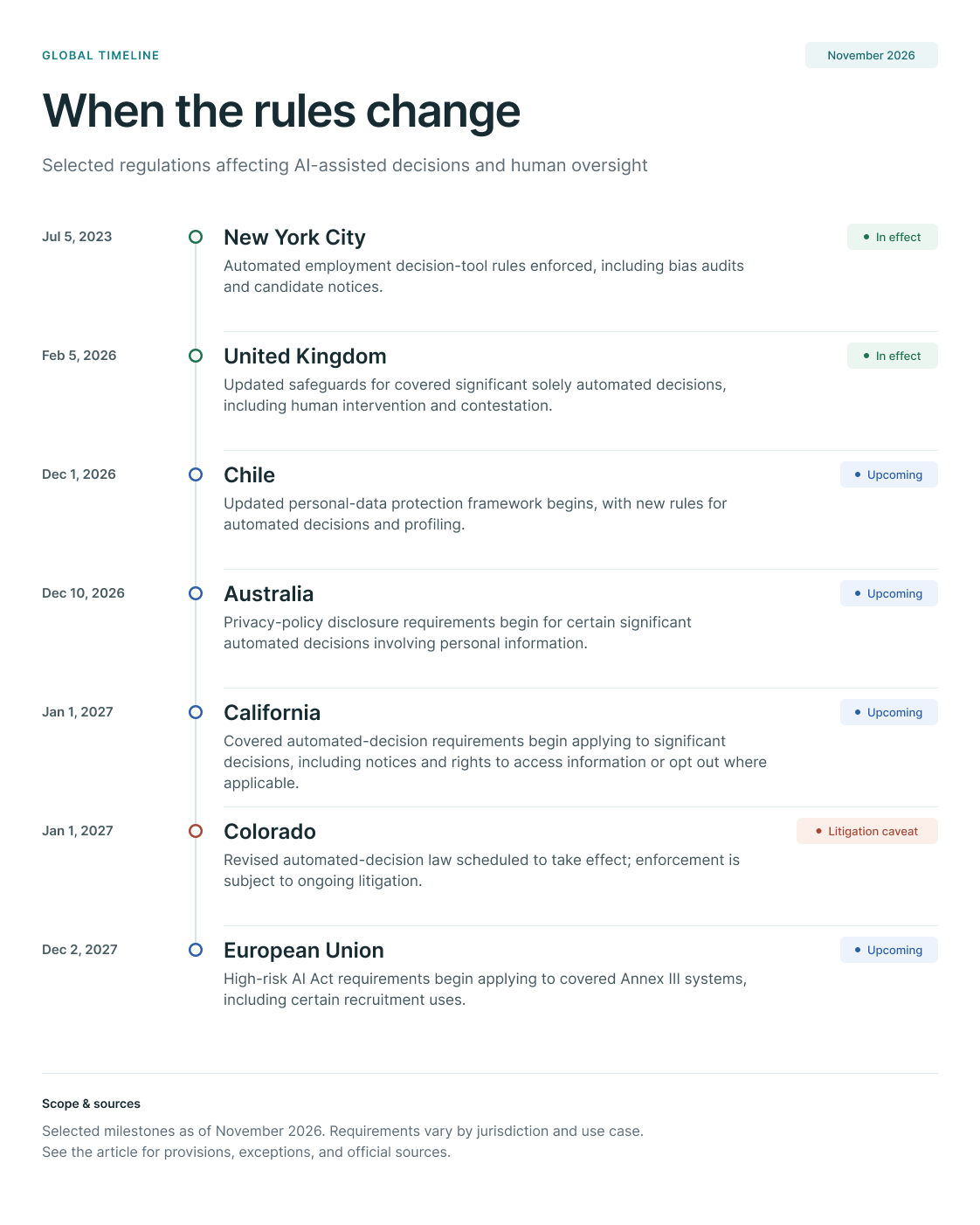
November 2026 snapshot of automated-decision rules across seven jurisdictions. New York City and UK rules are in effect. Milestones follow in Chile and Australia in December 2026, California and Colorado in January 2027, and the EU in December 2027. Colorado’s enforcement is subject to litigation.
Selected regulatory milestones as of November 5, 2026. Applicability and transition rules differ; Colorado’s enforcement status remains qualified.

The timing is concrete. New York City has enforced rules for certain automated employment decision tools since July 2023. The United Kingdom brought revised safeguards for significant solely automated decisions into operation on February 5, 2026. Australia will require certain automated-decision information in privacy policies from December 10, 2026. California’s specific automated decisionmaking technology requirements for covered significant decisions have a January 1, 2027 compliance date. Following the EU’s 2026 amendments, the AI Act’s Annex III high-risk requirements—including specified recruitment uses—are scheduled to apply from December 2, 2027. Colorado’s revised law has a January 1, 2027 statutory start, with an important litigation caveat concerning enforcement. These measures differ dramatically in scope, but they share a consequence: an AI feature can no longer be evaluated exclusively by how fast, smooth, or convincing it feels. NYC · UK GDPR · Australia OAIC · California final regulations · EU consolidated AI Act · Colorado SB26-189

I mapped the overlaps into 45 product-design concerns, grouped by when they affect the experience. This isn’t a claim that every AI product must implement 45 features. Some are statutory duties in covered situations; others are sensible implementation responses to those duties, or
recommendations from non-binding guidance. Making that distinction is essential. A law might establish the right to contest a decision without specifying a particular review-status screen. A designer still has to make the right usable.

The purpose of this inventory is to give us a way to make those distinctions deliberately, and to reveal the questions a product brief may have missed.

First, determine which rules can apply

Before opening the inventory, ask five questions.

What authority does the system have?
Does it generate or summarize material, recommend or rank options, materially influence a decision, determine an outcome, or execute an action? Those aren’t interchangeable activities.

What is at stake?
Choosing a playlist is different from assessing someone for a job, credit, housing, insurance, healthcare, education, or public benefits. Several laws focus on decisions with legal or similarly significant effects.

Whose information is involved?
Is the system processing personal information, sensitive data, information about children, biometrics, or material collected from third parties? Existing privacy and equality laws don’t disappear because AI is involved.

Who is responsible?
A provider making an AI system available, a company deploying it, and an organization controlling the personal data may each have different duties. Under the EU AI Act, provider and deployer obligations are distinct; Colorado also draws a developer/deployer distinction. The product’s admin settings might be designed by the vendor, but its customer may be responsible for candidate notice or an employment decision. EU AI Act · Colorado

Where, and when?
Jurisdiction may depend on more than the company’s headquarters. Verify who the product serves, where decisions occur, which law covers the activity, and whether the provision is in force, transitional, scheduled, disputed, or voluntary.

Only after answering these questions does a useful design audit begin. A universal checklist is a starting point for investigation, not a universal compliance recipe.

1. Before AI is used: people need to know what they’re entering

The first group of obligations affects the moment before an interaction, assessment, or use of personal information.

1. Disclose direct interaction with AI

The EU AI Act’s Article 50 addresses transparency for people interacting directly with certain AI systems; South Korea’s AI Basic Act includes advance notice requirements for covered generative or high-impact AI services. The relevant triggers and exemptions differ. EU AI Act, Art. 50 · South Korea, Art. 31

Design implication: Provide recognition at the moment it matters. An initial conversational disclosure may be appropriate; hiding the fact in a privacy policy may not be. This does not mean attaching an AI badge to every ordinary algorithmic feature.

South Korea’s commencement is not the same as unrestricted enforcement. MSIT confirms the Act and Enforcement Decree took effect on January 22, 2026 and announced an enforcement grace period of at least one year. Implementation should follow the current decree and transparency guidance; this announcement is not a claim that commencement itself was postponed. MSIT commencement announcement

2. Disclose when AI makes or influences consequential decisions

A person needn’t be a direct user of an AI interface to be affected by it. New York City imposes notices for covered automated employment decision tools. Quebec requires notification when an enterprise makes a decision based exclusively on automated processing of personal information. Other regimes use different thresholds, such as material influence or a significant decision. NYC rules · Quebec, §12.1 · Colorado

Design implication: Design for the person assessed, not just the person operating the system. A recruiter seeing an AI label doesn’t mean the candidate received the notice they’re entitled to.

3. Deliver notices at the required time

Timing is sometimes part of the obligation. New York City’s covered AEDT rules require the specified notice to covered candidates or employees who are NYC residents 10 business days before use. California’s covered ADMT requirements specify a pre-use notice. Colorado has separate point-of-interaction and post-adverse-outcome disclosure provisions. These aren’t interchangeable with a general banner. NYC FAQ · California, §7220 · Colorado

Design implication: Notices need an owner, an event trigger, a delivery channel and, where appropriate, a reliable record that they happened.

Workplace notice has its own audience and trigger. EU AI Act Article 26(7) requires employers deploying covered high-risk workplace systems to inform workers’ representatives and affected workers before putting the system into service or using it. Article 26(11) separately addresses informing people subject to specified Annex III systems’ decisions or assistance. Neither should be replaced with a notice shown only to a recruiter. These duties follow the relevant high-risk application timetable. Article 26

4. Describe what AI does, and what it does not do

Privacy transparency requirements and certain automated-decision provisions can call for meaningful information about the processing and the system’s role. A statement that a product “uses AI to improve your experience” rarely answers whether the AI summarizes evidence, ranks people, determines eligibility, or acts autonomously. EU GDPR, Arts. 13–15 and 22 · California ADMT rules

Design implication: Describe authority in terms a person can understand: prepares recommendations, ranks applications, makes the initial determination, or sends messages after approval. These distinctions also help teams uncover unnoticed delegation of judgment.

5. Disclose relevant personal-data inputs and uses

Transparency can extend to the categories of personal information processed and how a computer program contributes to significant decisions. From December 10, 2026, Australia’s APP 1.7–1.8 requires qualifying entities to include specified automated-decision information in their privacy policies. That’s a precise privacy-policy duty, not a requirement for a universal AI popup. Australia OAIC

Design implication: A privacy notice can only be accurate if the team knows which systems consume which information. Design documentation, data mapping and customer-facing language need to agree.

6. Provide lawful consent and withdrawal mechanisms when consent applies

Consent is one possible legal basis for processing personal information; it isn’t a magic fix for every AI feature. GDPR Articles 6–7 and comparable privacy laws place conditions on consent when it is used. EU GDPR

Design implication: Make the real choice understandable and withdrawal usable where required. Equally, don’t force a meaningless consent checkbox into a workflow that relies on a different lawful basis.

7. Restrict sensitive-data uses and protected-characteristic processing

Using personal data in employment, health, financial and biometric contexts can engage heightened privacy, discrimination, and sectoral rules. Some practices are restricted or prohibited rather than simply subject to a better notice. EU GDPR, Arts. 9 and 22 · EU AI Act, Art. 5

Design implication: Limit collection and access, test whether a field should exist, and create appropriate alternatives. Sometimes the right interface change is removing the capability.

8. Design age-appropriate experiences and protections for children

Children’s privacy and platform-safety rules may constrain profiling, advertising, default settings and interaction design. The EU Digital Services Act, for example, imposes specific requirements on accessible platforms used by minors. EU DSA, Art. 28

Design implication: Treat age, audience and risk as architectural inputs, not an extra setting added at the end.

9. Account for indirectly collected personal information

AI products increasingly process data the user did not provide directly: imported profiles, third-party sources, background records and information supplied by other people. New Zealand’s IPP 3A, in effect since May 1, 2026, introduces relevant notice obligations for indirect collection, subject to exceptions. New Zealand Ministry of Justice

Design implication: Make source and purpose visible where required. Don’t assume a dataset becomes ethically or legally uncomplicated because the current user uploaded it.

10. Treat biometric collection, consent and destruction as one experience

Illinois’s Biometric Information Privacy Act, §15, requires covered private entities to provide written collection and purpose/duration information, obtain a written release before collection, and maintain a public retention and destruction policy. Destruction generally follows the earlier of fulfilment of the collection purpose or three years after the person’s last interaction, subject to the statute’s qualifications. These duties concern covered biometric identifiers and information, not every photograph or audio recording. Illinois BIPA, §15

Design implication: For a covered face-template or voiceprint feature, connect onboarding to collection controls, retention settings and actual destruction. A generic privacy acceptance cannot stand in for the required release. A deletion confirmation must reflect what happened in storage and relevant service relationships, not only the disappearance of a profile picture. Check statutory definitions and exclusions before deciding a feature is covered.

2. When AI generates, recommends or assesses: the output needs context

The second group concerns the moment the system presents something apparently useful, a generated answer, a ranked list, an assessment or a decision explanation.

11. Identify covered synthetic content

The EU AI Act’s Article 50, China’s synthetic-content labelling rules and South Korea’s AI Basic Act establish different requirements concerning the identification of certain AI-generated or manipulated outputs. China’s measures took effect on September 1, 2025; South Korea’s Article 31 began operating in 2026, subject to its implementing framework. EU AI Act · China CAC · South Korea

Design implication: Decide where labels appear when material is created, edited, shared, downloaded or embedded. Different output categories may require different treatment.

12. Preserve machine-readable labelling and provenance where required

The problem isn’t always solved by a visible chip. Some rules address implicit identifiers or machine-readable formats attached to generated material. China CAC · EU AI Act, Art. 50(2)

Design implication: Export and publishing flows matter as much as the composition screen. A team must verify what happens to required identifiers after transformations, downloads and re-uploads.

EU timing and exceptions: Article 50(2)’s machine-readable marking duty is distinct from Article 50(4)’s deployer disclosures for deepfakes and specified public-interest text. The marking rule contains exceptions, including certain standard-editing assistance. Article 111(4) gives covered generation systems placed on the market before August 2, 2026 until December 2, 2026 to comply with Article 50(2). Do not apply that transition to every Article 50 disclosure. Article 50 · Article 111(4)

13. Explain significant recommendation parameters

The EU Digital Services Act requires covered online platforms to explain the main parameters of their recommendation systems in plain and intelligible language. This is not a general requirement to publish a model’s source code or weights. EU DSA, Art. 27

Design implication: Tell people the meaningful factors behind what they see, rather than simply saying “personalized for you.”

14. Provide recommendation controls and non-profiling options where applicable

The DSA also addresses options for changing or influencing recommender parameters. Article 38 imposes an additional non-profiling option on designated very large online platforms and search engines. Those requirements do not apply to every AI-powered product. EU DSA, Arts. 27 and 38

Design implication: Give people understandable controls over the actual factors they can change, and make mandated alternatives findable.

15. Give qualifying people information or explanations about automated decisions

A useful distinction: an explanation of a recommendation isn’t the same as a legal right to information about a decision. GDPR, the EU AI Act, Quebec law, Brazil’s LGPD, the UK GDPR and Chile’s forthcoming Article 8 bis establish different entitlements, conditions, and exceptions. They cannot be collapsed into one universal “right to an explanation.” EU AI Act, Art. 86 · Quebec, §12.1 · Brazil, Art. 20 · Chile, Art. 8 bis

Design implication: Build the disclosure and request process around the particular right. Do people need the main factors, personal information used, meaningful information about a decision, or a way to request more detail? Those are different product requirements.

Financial-services callout: reasons must be specific. Under US Regulation B, §1002.9, covered credit adverse-action notices must provide the principal reasons or the prescribed notice of the right to obtain them. A statement that an applicant failed an internal score is not an adequate substitute for specific reasons. An opaque model does not turn this into a requirement for persuasive explanatory copy; the product must be able to identify the actual decision factors. Regulation B, §1002.9(a)–(b)

Design implication: Preserve the connection between the reasons communicated and the decision actually made. A language model’s plausible reconstruction is not a dependable reason-generation mechanism. This credit-specific obligation does not automatically transfer to a hiring score.

16. Make important evidence and assumptions inspectable

This is where law meets design judgment. A statute might require explanation, oversight, accuracy or contestability without specifying an “Inspect evidence” panel. But a generated sentence describing a conclusion may not give someone the means to evaluate it.

In Search of Verifiability (2024), Raymond Fok and Daniel Weld examine the gap between explanations that sound plausible and information that people can verify. Their work does not establish a universal design pattern for hiring; it gives us a question worth testing: Can a person check the evidence behind the output?Fok and Weld

Design implication: Consider source passages, data provenance, applied criteria, alternative interpretations and clear signals when the system couldn’t reconcile information. Then test whether those additions help people find consequential mistakes.

17. Communicate known limitations without implying unsupported precision

The EU AI Act’s Article 13 requires information concerning covered high-risk systems’ performance, limitations and intended use. Colorado’s developer requirements likewise address technical documentation for covered ADMT. Neither creates a universal mandate to display—or ban—a confidence percentage. EU AI Act · Colorado

Design implication: Ask what a number means before displaying it. “92% match” can imply objectivity even when the underlying construct is difficult to validate. The relevant design outcome is accurate calibration of human trust, not the decorative presence of numerical certainty.

18. Supply appropriate instructions to organizations deploying the system

Some obligations attach to the provider-to-deployer relationship: intended uses, limitations, appropriate human review, and other information needed to operate the system. A notice to an affected person does not replace those instructions. EU AI Act, Art. 13 · Colorado

Design implication: Admin onboarding, operator guidance, system settings and product documentation become part of the design surface. A vendor should not advertise controls that a customer cannot actually configure or operate.

19. Put covered personalized-pricing disclosures beside the price

New York General Business Law §349-a addresses covered personalized algorithmic pricing using a consumer’s personal data. It requires a clear, conspicuous disclosure in the same medium, at or near and contemporaneous with covered price presentations. The prescribed wording is: “THIS PRICE WAS SET BY AN ALGORITHM USING YOUR PERSONAL DATA”. Insurance, specified financial institutions and certain subscription discounts are among the exceptions. New York, §349-a

Design implication: Connect the disclosure to the pricing event and preserve it across covered advertisements, offers and price displays. A generic footer about AI is a different experience. This is not a claim that every fluctuating price, demand-based price or discount uses the particular consumer’s personal data.

20. Design safeguards for ongoing companion-chatbot interactions

California SB 243, effective January 1, 2026, added Business and Professions Code §§22601–22606 for covered companion-chatbot operators. It requires disclosure where a reasonable person could mistake the chatbot for a human, a published protocol addressing suicidal or self-harm content, and additional safeguards for users known to be minors. Those include AI disclosure, default break and AI reminders at least every three hours during continuing interactions, and specified measures concerning sexually explicit conduct. The reporting duty begins separately, July 1, 2027. SB 243, chaptered text, §§22601–22603

Design implication: Treat the ongoing conversation as a designed service: identity cues, session timing, safety responses and operator processes all matter. Check the definition and exclusions; the law does not classify every productivity or customer-service bot as a companion. The precise notification timing is a legal requirement in the covered minor context, while the visual form and broader wellbeing features require design judgment.

Section 22604 also requires an accessible disclosure that companion chatbots may be unsuitable for some minors. That is separate from the known-minor reminders and should not disappear into a general AI label. SB 243, §22604

3. Before AI decides or acts: who has the authority?

A transparent recommendation can still become an unexamined decision. An approval screen may create the appearance of oversight without giving anyone a meaningful chance to change what happens.

21. Provide meaningful human oversight in covered contexts

EU AI Act Article 14 addresses oversight for high-risk systems. The UK’s revised automated-decision framework asks a different legal question: whether significant decisions are taken with meaningful human involvement, and which safeguards apply when they are solely automated. EU AI Act, Art. 14 · UK GDPR, Arts. 22A–22C

Design implication: Give appropriately qualified reviewers sufficient information, authority, and opportunity to intervene. A final approval step is not inherently meaningful oversight.

California uses an operational human-involvement test too. Section 7001(e) defines covered ADMT by replacement or substantial replacement of human decision-making. Its human reviewer must know how to interpret the output, review and analyse it alongside other relevant information, and have authority to make or change the decision. A human approval click alone does not establish that a use falls outside this definition. CPPA final regulations, §7001(e), pp. 1–2

22. Make rejection, correction and override possible where required

Covered oversight frameworks contemplate humans being able to understand, disregard, override or otherwise intervene in relevant AI outputs. The precise powers depend on the regulation and system. EU AI Act, Art. 14(4)

Design implication: Design intervention where it can change the outcome. A button that changes a displayed score but leaves downstream decisions untouched may be ineffective.

23. Test whether human involvement is more than rubber-stamping

In his 2022 paper, The Flaws of Policies Requiring Human Oversight of Government Algorithms, Ben Green examined policies requiring human oversight and challenged the assumption that placing a person into an automated workflow necessarily protects against its errors. The research concerns government systems, not private hiring software, but the design question travels: what would a reviewer have to notice, understand and be authorized to change to improve an outcome? Green

Design implication: Measure error detection and actual intervention, not only approvals completed or user satisfaction. EU AI Act Article 14(4)(b) specifically addresses automation bias in the relevant high-risk context. EU AI Act

24. Avoid prohibited or unlawfully automated decision paths

Some legal problems cannot be fixed with extra disclosure. EU AI Act Article 5 prohibits specified practices. Data-protection frameworks may restrict certain solely automated significant decisions, subject to defined exceptions and safeguards. High-risk classification is not the same thing as prohibition. EU AI Act · EU GDPR, Art. 22

Design implication: Consider whether the system should make the judgment at all. Don’t treat every prohibited or unjustified workflow as a request for a better confirmation modal.

A concrete prohibition: EU AI Act Article 5(1)(f) restricts AI emotion inference in workplaces and educational institutions, with medical or safety exceptions. A candidate agreeing to an interview interface does not by itself make a prohibited emotion-inference feature permissible. Do not confuse recognizing a facial expression with establishing that a covered emotion-inference use is lawful. AI Act, Article 5

25. Define the authority of autonomous agents

Agents can have permission to read private data, update records, send messages, publish material or initiate transactions. Singapore’s updated May 2026 Model AI Governance Framework for Agentic AI recommends bounding those capabilities. It is voluntary guidance, not a general new statutory approval-button requirement. Singapore IMDA

Design implication: Make action scope legible. Define permitted tools, data access, recipients, spending limits and downstream systems; use restricted defaults when the cost of a mistake is high.

26. Place human checkpoints before consequential actions

For an agent, “review” can happen before or after its action. That difference becomes significant when the action is hard to undo. Singapore’s framework recommends meaningful checkpoints, while the EU AI Act addresses oversight for covered high-risk systems. Singapore IMDA · EU AI Act

Design implication: Separate permission to prepare an email, payment or account change from permission to send or execute it. Checkpoints should reflect impact and reversibility, not simply frequency.

27. Make interruption and containment real

For covered high-risk systems, EU AI Act Article 14(4)(e) addresses being able to interrupt a system through a stop button or similar procedure. Singapore’s framework offers broader guidance on technical controls. This isn’t a universal mandate for a stop button in every AI feature. EU AI Act · Singapore IMDA

Design implication: Show what is still pending, what has completed, and what stopping the system will actually prevent. A pause control that doesn’t cancel the relevant queued actions is a misleading promise.

28. Examine manipulative interfaces and AI-driven choice architecture

DSA Article 25 restricts covered online platforms’ interface designs that deceive, manipulate or materially impair free and informed decisions; its scope excludes practices covered by the Unfair Commercial Practices Directive or GDPR. EU AI Act Article 5(1)(a)–(b) uses different tests for prohibited manipulative or exploitative AI practices, including its harm conditions. These are not interchangeable bans on persuasion. DSA, Article 25 · AI Act, Article 5

Design implication: Review defaults, unequal choice prominence, repeated prompts and AI-personalized pressure. An accurate answer can still be embedded in an unlawful choice experience. Assess the applicable legal test before treating an engagement technique as acceptable merely because the user clicked it.

29. Give algorithmic management of platform workers its own decision boundaries

The EU Platform Work Directive (2024/2831) addresses automated monitoring and decision systems used by digital labour platforms. Articles 9–11 concern information, oversight, explanation and review. Article 10(5) requires decisions restricting, suspending or terminating a person’s account or contractual relationship, or decisions of equivalent detriment, to be taken by a human. Member States must transpose the directive by December 2, 2026; national implementation matters. Directive, Articles 9–11 and 29

Design implication: Map who may actually decide, not only who can appeal afterward. A platform may need worker-facing reasons, qualified contact people, review routes and controls preventing an automated account termination. This platform-work directive does not automatically govern every workforce dashboard or PeopleSync’s ordinary hiring example. Other employment and data-protection rules may apply there.

4. After AI finishes: the decision may not be over

Product interfaces tend to end at success or failure. Automated decisions and actions can create another set of experiences: requests, corrections, challenges, reconsideration, and recovery.

30. Allow qualifying decisions to be challenged

The UK GDPR’s Article 22C, Quebec’s §12.1 and Chile’s new Article 8 bis establish distinct protections or processes relating to automated decisions. Chile’s reforms begin on December 1, 2026. Their triggers and remedies are not identical. UK GDPR · Quebec · Chile

Design implication: Where required, a person should be able to find and exercise the actual right. A generic support link may be insufficient as a product response if no review process exists behind it.

31. Provide human reconsideration when the relevant law calls for it

The UK’s safeguards include human intervention for qualifying decisions. Quebec provides an opportunity to submit observations to a staff member able to review the decision. Colorado’s revised law establishes a right to request meaningful human review after specified adverse consequential decisions. Brazil is an important exception to careless generalization: LGPD Article 20 provides a review right for certain solely automated decisions without universally requiring a human reviewer. UK · Quebec · Colorado · Brazil

Design implication: Establish who reviews the case, what authority they have, and what reconsideration can change. Don’t collapse different statutory rights into a single “Appeal” button.

32. Correct inaccurate personal information

Data-protection laws in many jurisdictions provide rights to correct inaccurate personal information. A wrong employment date, identity match or address can influence downstream automated assessments. EU GDPR, Art. 16 · Brazil LGPD

Design implication: Distinguish correcting source records, correcting what AI extracted, and disputing an AI judgment. Those are three different operations.

33. Address downstream consequences of corrections

This is a design and operational response, not a globally standardized legal requirement to reverse every previous output. If a candidate’s record is corrected after a rejection, the organization must decide whether the assessment or action also needs review under the applicable processes.

Design implication: Make dependencies inspectable. Show when a correction affects an existing decision, a notification already sent, or an action that cannot be recalled.

There can also be a specific notification duty. GDPR Article 19 requires controllers to communicate qualifying rectification, erasure or restriction to recipients of the personal data, unless impossible or disproportionate, and to identify those recipients to the person on request. This does not itself mean that every earlier decision must be reversed. It gives the downstream-correction discussion a legal anchor in addition to the proposed recovery workflow. GDPR, Article 19

34. Support access, erasure, portability and objection rights

Existing privacy frameworks remain relevant to AI products: GDPR Articles 15, 17, 20 and 21, Brazil’s LGPD, California’s privacy law and others can establish rights over personal information, subject to their respective conditions. EU GDPR · California CPPA

Design implication: Rights-request journeys and data inventories cannot be an afterthought. Deleting something from a visible conversation may not satisfy a request concerning information stored or used elsewhere.

Retention and deletion need defined limits. GDPR Article 5(1)(e)’s storage-limitation principle and Article 17’s qualified erasure right should inform what is kept, for what purpose and for how long. Deletion is not unlimited: exceptions and other recordkeeping duties can apply. Map source records, extracted data, indexes, decision logs and vendor copies, and accurately explain any information retained under an applicable exception. GDPR, Articles 5 and 17

35. Provide covered opt-outs or alternatives

California’s ADMT regulations provide defined pre-use notice, access and opt-out rights for covered significant decisions, with exceptions. The specific ADMT requirements have a January 1, 2027 compliance date. The DSA’s non-profiling recommendation choice for designated very large platforms is a separate legal mechanism. California final ADMT regulations · EU DSA

Design implication: Offer an actual covered choice, accurately explain what changes, and avoid presenting a universal opt-out when the particular law or feature doesn’t establish one.

36. Communicate how review requests progress and resolve

A review right needs an operational process; a particular dashboard or set of status labels is generally a design choice rather than a statutory template.

Design implication: Acknowledge a request, identify responsible parties, explain the relevant process, and communicate its outcome where appropriate. Make promises only if the organization can fulfill them.

37. Support recovery from actions an agent has executed

Stopping an agent won’t recall an email or reverse a purchase already completed. Singapore’s guidance addresses agent powers and operational controls, but does not establish a universal right to undo every agent action. Singapore IMDA

Design implication: Make completed, pending and reversible actions distinguishable, with routes to remediation when an action cannot simply be undone.

38. Explain covered moderation restrictions and provide usable complaints

DSA Article 17 requires covered hosting services to give statements of reasons for specified restrictions, including relevant information about automated means. Article 20 requires covered online platforms to provide an accessible internal complaints system for qualifying moderation decisions; complaint decisions must be supervised by appropriately qualified staff and not taken solely by automated means. Scope and exemptions, including Article 19, matter. DSA, Articles 17, 19–20

Design implication: Connect the restricted post, visibility, monetization or account state to an intelligible reason and the applicable complaint route. Preserve enough context to reconsider and reverse a mistaken restriction. A generic “our AI detected a violation” message does not communicate the relevant rule, facts and remedy. These protections are distinct from the employment and credit processes elsewhere in this inventory.

5. Across the lifecycle: accountability is a product capability

Several obligations don’t live in a single screen. They affect what a team can measure, document, govern, and repair.

39. Support risk and impact assessment

GDPR Article 35 can require a data protection impact assessment for qualifying high-risk processing. EU AI Act Article 27 establishes fundamental-rights impact assessments for specified deployers of covered high-risk systems. California has adopted risk-assessment requirements with a timetable distinct from its ADMT compliance date. Canada’s federal Algorithmic Impact Assessment is relevant to covered public-sector use. GDPR · EU AI Act · CPPA · Canada

Design implication: Document workflows, affected people, assumptions, failure modes, human interventions, and alternatives to the proposed automation.

Do not make Article 27 universal. Its fundamental-rights assessment covers specified public-law bodies, private entities providing public services and deployers of specified creditworthiness and life/health-insurance systems, with an Annex III exclusion. It is not automatically a duty for every private employer using a recruitment tool. A separate GDPR DPIA may still be required. Record the actual trigger, affected groups, oversight measures, complaints arrangements and updates; do not relabel every risk worksheet a statutory FRIA. Article 27

40. Make bias auditing and discrimination testing possible

NYC’s Local Law 144 requires covered AEDTs to have a recent bias audit, make audit information publicly available and provide required notices. Illinois’s employment AI provisions address discrimination and notice but are not simply the same audit regime. Existing disability and anti-discrimination rules can also apply to AI-assisted assessments. NYC · Illinois

Design implication: Support appropriate testing and audit inputs; measure false exclusion and disparate effects, not just overall precision. Understand which organization owns the audit obligation.

41. Preserve proportionate records and traceability

EU AI Act Articles 12, 19 and 26 concern logging and recordkeeping in covered high-risk contexts. Colorado also establishes records duties for covered developers and deployers. These obligations coexist with privacy and retention limitations. EU AI Act · Colorado

Design implication: Keep appropriate records of decisions, inputs, model or workflow versions, interventions, and executed actions, with access and retention limits rather than indiscriminate perpetual logging.

Recordkeeping is bounded. In the relevant context, Article 26(6) sets an at-least-six-month period for deployer-controlled automatic logs, subject to its qualifications and other applicable law. That is not permission to keep every résumé, conversation and biometric template indefinitely. Set schedules by record category, restrict access, and test expiry and destruction. Article 26(6)

42. Monitor failures and support corrective action

Some high-risk systems face post-market monitoring, incident and corrective-action duties. Other systems face relevant sectoral or consumer-protection expectations. EU AI Act, Arts. 72–73

Design implication: Build trustworthy error signals, escalation paths, incident visibility and ways to limit or disable problematic functionality. Don’t assume a support ticket queue alone is an adequate operational response.

43. Design accessibility and accommodations into AI workflows

Accessibility and non-discrimination requirements predate generative AI. Hiring, education, government and other high-impact contexts can require usable alternatives or reasonable accommodations. UK responsible recruitment guidance is a concrete example of how these issues arise with AI tools. UK government recruitment guidance

Design implication: Test AI-assisted interfaces with assistive technology, offer appropriate alternatives and accommodations, and ensure scoring or processing does not accidentally penalize people for needing them.

44. Design for the responsibilities of providers and deployers

A platform’s user interface is only part of a contractual and legal ecosystem. Under the EU AI Act, providers and deployers have separate responsibilities. Colorado differentiates covered ADMT developers and deployers; GDPR distinguishes controllers and processors. EU AI Act · Colorado · GDPR

Design implication: Be explicit about who can configure notices, perform reviews, access documentation, investigate incidents and retain records. A vendor can’t fulfill every customer’s legal duty simply by shipping a setting.

45. Support AI literacy and prepare the people operating the system

EU AI Act Article 4 has applied since February 2, 2025. Its amended wording requires providers and deployers to take measures supporting staff and other people operating AI on their behalf in developing AI literacy, considering their experience, training, use context and affected people. It does not require guaranteeing a specific proficiency level for every individual. Article 4 · Commission questions and answers

Design implication: Combine role-specific onboarding, contextual instructions, practice with failure cases and organizational training. A recruiter needs preparation for reviewing evidence and overriding an assessment; an administrator needs preparation for configuring authority and responding to incidents. The law does not prescribe a universal tutorial, mandatory quiz or particular interface component.

6. Let’s test the list against a product

A reference becomes more useful when we apply it to a workflow. So imagine an AI-assisted hiring platform called PeopleSync. The product and situation are fictional. The example illustrates decisions a product team would need to investigate; it is not a finding about a real employer or a claim that one interface can establish compliance everywhere.

A team is hiring a Product Designer. PeopleSync receives 214 applications, uses AI to evaluate candidates, ranks 12 for closer consideration and recommends the top five for interview. The recruiter sees a polished dashboard, a score for each candidate, a brief explanation and an approval button.

One candidate, Alex Chen, has six years of relevant design experience, including independent client work from 2023 through 2025. Alex took time away from full-time employment, changed industries and developed relevant skills through independent projects. The system interprets the absence of a recent full-time employer as weak experience continuity, overlooks relevant work and places Alex eighth, with a 72% match score.

The explanation sounds reasonable: The candidate’s recent professional experience does not closely match the position’s requirements. Nothing looks obviously wrong. The recruiter selects Approve Top 5 for Interviews. Alex never reaches the interview stage.
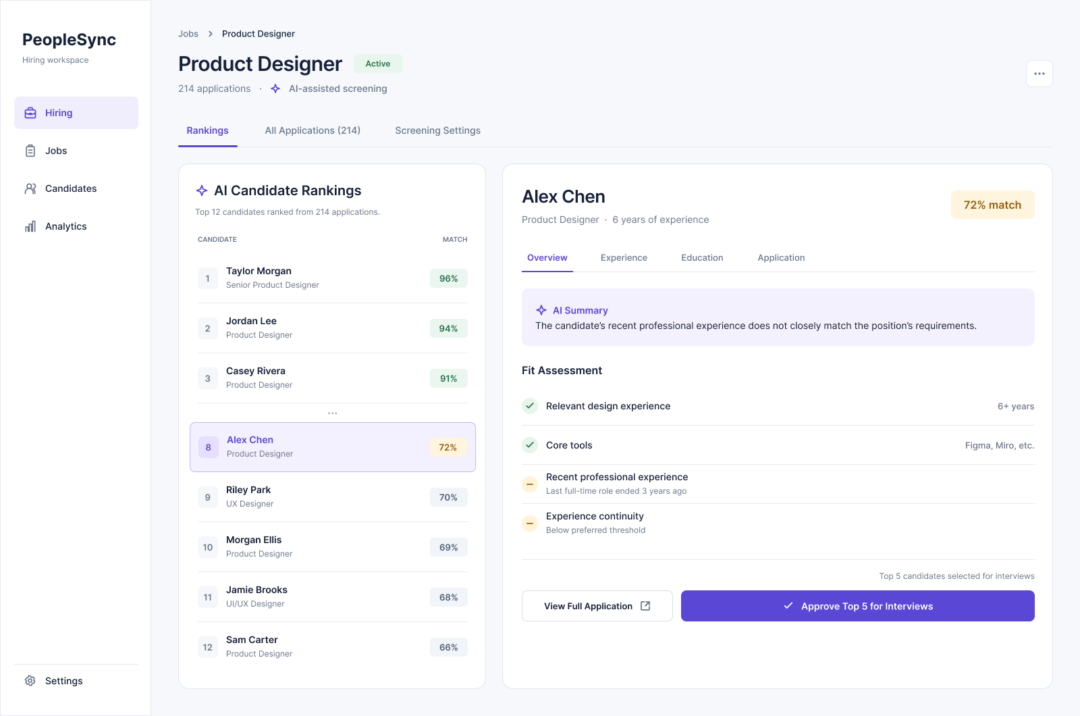
PeopleSync ranks 12 candidates from 214 applications. Alex Chen is eighth with a 72% match. The AI summary questions Alex’s recent experience, and the recruiter can approve the top five for interviews in one click.

PeopleSync’s original workflow: the recruiter can approve the shortlist without seeing which evidence informed the assessment.

The approval button worked exactly as designed. The oversight didn’t.

The organization also made an important decision before the recruiter ever opened the dashboard: it decided which judgments the machine was allowed to make. The eventual interface cannot be evaluated independently of that choice.

Which parts of this example are actually regulatory?

We need to establish the relevant employer, vendor, location, processing and decision before reaching a legal conclusion. A New York City covered AEDT, a qualifying EU high-risk recruitment system and a significant solely automated decision under a privacy law are different legal classifications. The same product can engage more than one regime, or fall outside a particular provision.

For the EU oversight discussion, assume PeopleSync is a covered Annex III recruitment system that materially influences candidate selection, with the vendor acting as provider and the employer as deployer. Articles 13–14 concern provider-side transparency and oversight design; Article 26 assigns relevant employer/deployer duties. The Chapter III Annex III requirements are scheduled for December 2, 2027, subject to Article 111’s existing-system transitions. This assumption does not establish that the recruiter’s decision is exclusively or solely automated under a separate privacy-law test. AI Act, Articles 6, 13–14, 26, 111 and 113

Throughout this case, I distinguish three things:

  • Legal obligation, where applicable: a provision establishes a duty or right once its conditions are met. Examples include NYC’s covered audit and notice requirements, or GDPR rectification rights.
  • Implementation choice: a team selects a workflow or interface to help fulfil an obligation. An evidence panel or a candidate review form may be useful, without its particular layout being prescribed by law.
  • Research-backed hypothesis: a proposed design draws on research but still needs validation in this setting. Hiding an initial ranking, comparing interpretations and adding deliberate friction belong here.

These can overlap. An oversight duty may motivate an evidence panel, while research informs how and when the panel appears. The duty can be binding even though the chosen solution remains a hypothesis.

An explanation isn’t understanding

Return to the recruiter reading Alex’s assessment. The system has supplied a reason for its conclusion. But what can the recruiter actually do with it?

They do not know which experience was considered relevant, how the break from full-time employment affected the assessment, or whether independent projects were interpreted correctly. They have received a justification without the evidence needed to evaluate it.

Explanations are frequently treated as the solution to AI opacity. When users do not understand a recommendation, the instinct is to add a Why this result? button. Click it, read the explanation, move on. That may improve understanding of the system’s stated reasoning without helping the person determine whether it is right.

In their 2024 paper, In Search of Verifiability, Raymond Fok and Daniel Weld examine why explanations often fail to improve human–AI decision-making. Their account emphasizes whether an explanation makes verification possible and affordable. It does not establish that every explanation fails, or that showing source material proves a hiring judgment correct. It changes the question we should ask of an explanation: What can this person check? Fok and Weld

Consider an AI assistant summarizing a research report. It might explain that it identified the document’s most important themes. That describes its approach. Showing the passages supporting particular claims gives the reader something to inspect. The reader can discover that a quoted passage does not support the summary, even if evaluating the report’s overall quality requires more expertise.

Similarly, telling a recruiter that Alex has insufficient recent experience does not establish whether the conclusion is justified. Showing the experience identified, the criterion applied and the information the system could not interpret creates an opportunity to examine the assessment. It also exposes another question: is the criterion itself appropriate for the job?

That is a design hypothesis, not a scientifically validated PeopleSync solution. Evidence can be incomplete or misleading too. But it gives us a more useful objective than making AI appear explainable.

What I’d change in the candidate assessment

I would remove or demote the score unless the team could demonstrate what it measures, how well it is calibrated and how it changes reviewers’ decisions.

72% match and 92% confidence are not interchangeable measures. Neither explains itself. Is the system confident about extracting a job title, interpreting experience, satisfying a requirement or predicting suitability? A precise-looking number can become another reason to accept a recommendation when its meaning is unclear.

Instead, I would present information the recruiter can investigate. For Alex, the assessment might read:

This is illustrative microcopy. The six-of-seven count describes the system’s extraction, not proof that Alex has or lacks a skill. “Incomplete” describes the assessment, not the candidate’s quality. The interface should make those distinctions explicit.
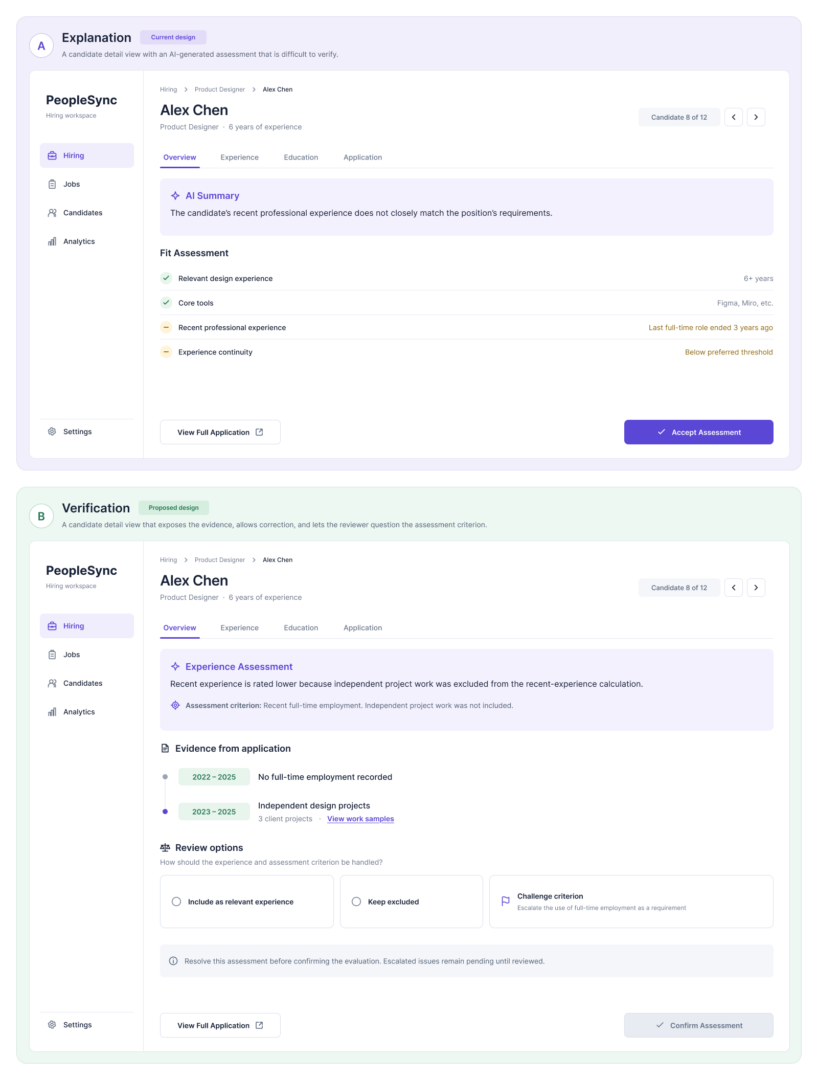
Two PeopleSync screens compare how a recruiter reviews Alex Chen’s assessment. The original offers an AI summary and an Accept Assessment button. The redesign shows three excluded client projects and lets the reviewer count them, keep them excluded, or challenge the full-time employment criterion.

The proposed interface exposes omitted experience and provides correction and escalation controls. This is a design proposal, not a legally prescribed screen.

The recruiter could inspect the source material, see three independent client projects, compare them with the documented criterion, and include relevant work or escalate a questionable criterion. A pilot could require resolution of a material evidence dispute before routine confirmation proceeds. That is a proposed checkpoint, not a claim that legislation requires a blocking modal for every uncertainty.

I would also distinguish changing a result from correcting the information that produced it. Moving Alex from eighth to fifth does not fix the system’s misunderstanding of the résumé. Correcting an employment date does not guarantee that every assessment using the old date has been updated. The interface needs to expose the relationship between source information, extracted information, assessment and action.

Comparison is another direction worth investigating. In their 2025 study, Contrastive Explanations That Anticipate Human Misconceptions Can Improve Human Decision-Making Skills, Zana Buçinca and colleagues found improvements in independent decision-making skills with contrastive explanations in the studied exercise-prescription task. Their experiment compared AI explanations that addressed likely human reasoning with unilateral explanations. It did not test recruitment. Buçinca et al., 2025

For PeopleSync, that raises a design question: would reviewers make better judgments if they could inspect competing interpretations—no recent full-time employment and recent relevant independent work—rather than only the system’s preferred conclusion? A simple side-by-side presentation would not reproduce the research intervention. It would be a new implementation to test.

There is a trade-off. More evidence means more reading. Additional review options increase complexity. A dashboard overflowing with supporting material can be as unhelpful as one that reveals nothing. I would use progressive disclosure to surface material uncertainties immediately, with supporting evidence available when needed, and test whether reviewers detect deliberately incorrect assessments. Asking only whether the explanation was understandable would miss the central failure.

Regulatory connection: EU AI Act Article 13 concerns information providers supply to deployers of covered high-risk systems. Article 86 concerns a conditional explanation right for affected people in specified decisions based on Annex III high-risk outputs. These have different audiences, scope and timing. The requirement concerns effective oversight and appropriate information in the covered context. Showing source evidence and unresolved interpretations is our proposed implementation; the law does not prescribe this particular screen. A recruiter-facing evidence panel does not, by itself, discharge a candidate’s information rights. Article 13 · Article 86

Human oversight is not a button

Suppose we improve the assessment. The recruiter can inspect evidence, review qualifications and flag questionable interpretations. Uncertainty is no longer hidden behind a score.

The recruiter still has dozens of applications to review, limited time and an organized shortlist already prepared by AI. Under those conditions, reviewing the system’s work can become an exercise in confirming that nothing looks obviously unusual.

In The Flaws of Policies Requiring Human Oversight of Government Algorithms (2022), Ben Green examines 41 policies prescribing human oversight. He challenges the assumption that inserting people into an automated process necessarily makes it safer or more accountable. His analysis concerns government systems and argues for institutional oversight, not simply improved approval screens. It does not directly establish how recruiters behave in PeopleSync. Green

The question it prompts here is concrete: what must be true for the reviewer to improve the decision? They need relevant information, competence and time to evaluate it, authority to change the outcome, and an opportunity to intervene before consequences become difficult to reverse. An employer also needs an organizational process that supports disagreement rather than rewarding approval throughput alone.

Without those conditions, a review step can become an administrative formality. A vendor cannot manufacture meaningful oversight by putting a customer’s name beside an approval event.

The legal significance of rubber-stamping

This distinction has consequences beyond usability. The UK’s amended GDPR Article 22A makes meaningful human involvement relevant to whether a decision is solely automated; Article 22C provides safeguards for qualifying significant solely automated decisions, including information, representations, human intervention and contestation. Those safeguards do not create an identical review right for every AI recommendation. UK GDPR, Articles 22A–22C

The ICO has cautioned that rubber-stamping an AI recommendation does not necessarily take a decision outside automated-decision protections. Its older AI guidance should be read alongside the amended legislation, rather than used as a substitute for the current statutory test. The quality of involvement matters as well as its presence. ICO, individual rights in AI systems

A related issue arose in the Court of Justice of the European Union’s 2023 SCHUFA judgment. The case concerned credit scoring. The Court held that automated creation of a creditworthiness probability could itself constitute automated individual decision-making under GDPR Article 22 where a third party drew strongly on it to establish, implement or terminate a contractual relationship. CJEU, C-634/21

SCHUFA was not about hiring approval buttons. It does not mean every AI score is automatically a regulated decision. Its relevance is that a score can matter legally because of how strongly another organization relies on it, even when that organization formally makes the subsequent decision. For recruitment platforms, it prompts investigation of the vendor’s and employer’s actual roles, not an assumption that responsibility follows ownership of the interface.

EU AI Act Article 14(4)(b) explicitly addresses automation bias in the covered high-risk oversight context. The relevant Annex III high-risk requirements are scheduled for December 2, 2027 under the amended timetable, subject to transitions; that future date does not postpone existing privacy or discrimination obligations. Article 14 · Article 113

For PeopleSync, I would therefore investigate whether reviewers can recognize mistakes, question assumptions and change outcomes in practice. That evaluation is a proposed way to substantiate oversight. It is not a claim that a statute mandates the particular user test described here.

When convenience works against judgment

Designers have spent years shortening forms, removing unnecessary steps and making software easier to use. Much of that work is valuable. In an AI-assisted assessment, the same instincts can make it easier to accept a recommendation without examining it.

In To Trust or to Think (2021), Zana Buçinca, Maja Barbara Malaya and Krzysztof Gajos studied cognitive forcing interventions intended to encourage more active engagement with AI advice. In their experiment, such interventions reduced overreliance compared with simple explainable-AI approaches, but the interventions that helped most received less favourable subjective ratings. Benefits also differed with participants’ motivation to engage in effortful thinking. These results are not evidence that adding friction improves every decision process. Buçinca, Malaya and Gajos

An interface people prefer is not necessarily the one that helps them make better decisions. Equally, an irritating interface is not necessarily a safer one. Repeated warnings become background noise. Mandatory confirmations become habitual. If every uncertain assessment requires intervention, reviewers can spend their day clearing alerts rather than examining applications.

I would want evidence about which interventions improve decision quality under realistic working conditions before adding them. That brings us to three alternative PeopleSync workflows.

First: improve the final approval

Keep automated ranking, but make final review more informative. Show source evidence, unresolved interpretations and material changes since the recruiter’s previous review. Preserve the ability to reject or correct the assessment and escalate a concern before interview invitations or rejections are sent.

This keeps much of the efficiency customers expect from screening software. It also preserves a significant problem: the system has already determined which candidates belong near the top. The recruiter starts with AI’s ordering as the reference point. Applicants omitted from the twelve may receive even less scrutiny than Alex, who at least appears in the displayed set.

Charvi Rastogi and colleagues investigated anchoring in Deciding Fast and Slow (2022). Their experiments examined interventions affecting reliance on AI advice, including improvement under particular conditions when AI recommendations were incorrect. They did not establish how often recruiters anchor on candidate rankings, or that delaying every recommendation would improve hiring. Rastogi et al.

The PeopleSync hypothesis is that seeing a ranking before forming an independent assessment can influence the recruiter’s conclusions. I would compare assessments of the same evidence with and without the ranking initially visible, and examine error detection, attention to lower-ranked candidates and decision quality. The study design should account for learning and order effects so participants are not simply remembering a previous candidate review.

If an informative approval screen mainly makes reviewers more confident in the original ranking, we have not shown that oversight improved.

Second: review important assumptions earlier

Instead of waiting for the completed shortlist, surface material uncertainties while applications are being assessed. Perhaps the system cannot determine whether independent project work satisfies an experience criterion. Employment dates may conflict across documents. An extracted qualification may not match the source.

The recruiter can investigate before that interpretation influences the final assessment. This moves intervention closer to where the error originates. For Alex, it could prevent relevant client projects from disappearing into an inaccurate continuity judgment.

The trade-off is operational complexity. Some flags will deserve attention; others will be immaterial or easily resolved. A system that raises an alert for every uncertainty may turn recruiters into exception processors. The product also needs a policy for unresolved cases: hold the assessment, seek clarification, escalate or proceed under an approved rule. A generic “continue anyway” control could undermine the checkpoint.

I would test the frequency and importance of flags, the share that reveal real errors, missed errors the system never flags, time spent resolving each issue and consequences for candidate waiting time. I would also check who can alter criteria and whether such changes are applied consistently across candidates.

The legal connection is to applicable accuracy, oversight and non-discrimination duties. The timing and form of this checkpoint are implementation choices. The question is whether earlier intervention produces better assessments, not simply more human activity.

Third: change what AI is allowed to decide

This is the approach I would examine most seriously. What if we remove automated suitability ranking?

PeopleSync could still organize the 214 applications, retrieve relevant evidence, extract qualifications with source references and identify information requiring clarification. Appropriately qualified reviewers would assess candidates against documented, job-related criteria without beginning from an AI-generated order of preference. The product would distinguish information completeness from candidate quality.

That changes the product proposition. Customers buy screening platforms to reduce work. Removing ranking may increase review time, operating costs and the effort required from recruiters. The change needs evidence that its benefits justify those costs. An impossible workload can undermine a nominally human process too.

There is a subtler problem: removing ranking does not remove AI’s influence. Extraction can miss relevant experience. Summaries can emphasize some facts and omit others. The default order of the review queue can determine who receives attention before interview slots fill. A badge saying “complete” can become an unofficial suitability signal even when the team did not intend one.

AI does not need to make the final decision to influence it.

I would preserve access to original applications, distinguish extracted information from source evidence, make omissions and misinterpretations easier to identify, and examine whether presentation order introduces its own bias. The narrower workflow then needs comparison with the original. It cannot be declared superior merely because a human now assigns the final assessment.

None of the laws cited here imposes a general ban on automated candidate ranking. Prohibition of a particular practice, classification as high-risk and a team’s decision to narrow automation are different matters. The third workflow is a product and governance proposal, informed by research and applicable duties.
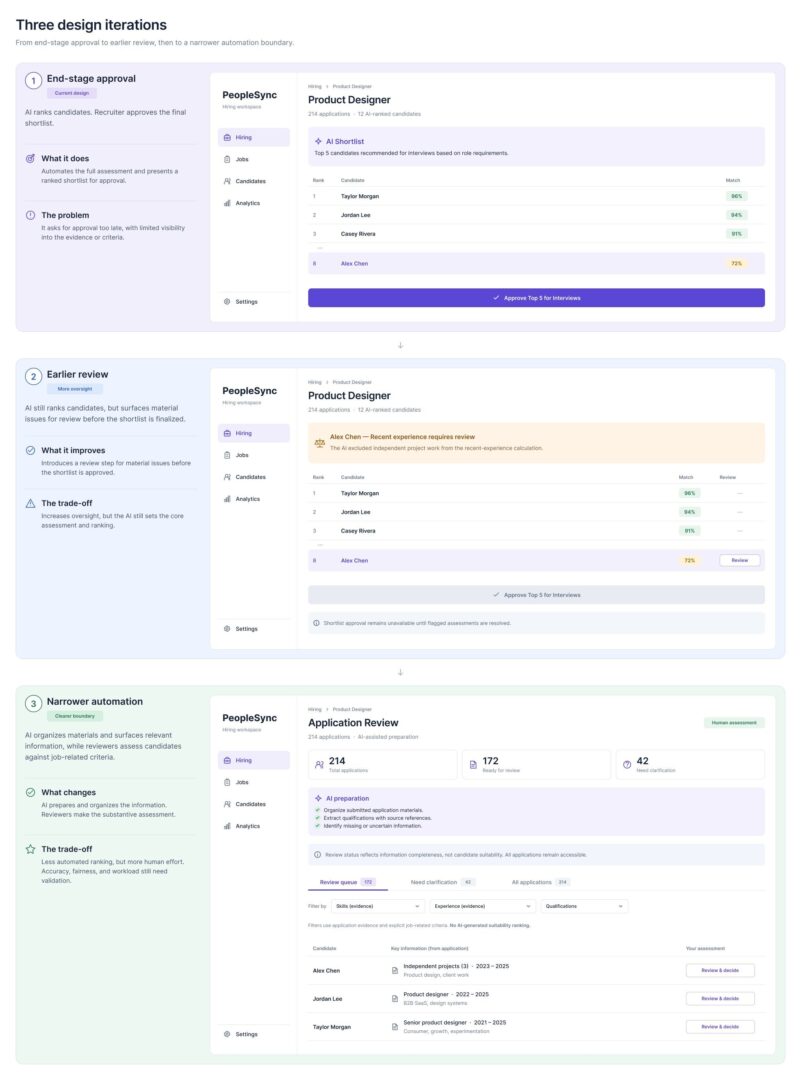
Three PeopleSync workflows show who assesses candidates and when. First, AI ranks candidates and the recruiter approves the shortlist. Second, AI still ranks candidates, but flagged assessments must be resolved before approval. Third, AI organizes application materials and reviewers assess candidates against job criteria.

The first panel shows the original approval screen. The article’s first proposal keeps approval at the end and adds evidence and review controls. The other two panels show earlier review and a workflow where reviewers assess suitability. Each proposal needs testing for accuracy, fairness and workload.

What evidence would justify shipping?

Before shipping ranking, I would want evidence that its assessments are appropriate, consequential errors and unfair disparities have been evaluated, and reviewers can identify mistakes under realistic conditions.

That means representative applications, deliberately introduced errors, realistic time constraints and the information reviewers will actually have. Test conflicting dates, missing project work, plausible but unsupported explanations, incorrect skill extraction and misleading summaries. Include applicants outside the displayed shortlist, not only errors in candidates the product has already selected for attention.

I would examine qualified candidates incorrectly excluded and unsuitable candidates incorrectly advanced. Overall accuracy can conceal systematic differences across relevant groups. Test accessibility and accommodations too, while collecting any sensitive evaluation information through an appropriate lawful process.

There is no universal error-rate threshold that makes every hiring system acceptable. Performance criteria should reflect consequences, applicable legal requirements and the organization’s ability to identify and address failures. A statutory bias audit, where required, answers a particular legal question; it should not be presented as proof that every aspect of this broader evaluation is satisfactory.

If reviewers consistently miss consequential planted mistakes, I would not ship the proposed ranking workflow unchanged. I would change the assessment or review process, narrow automation, or remove ranking until the problem is addressed. That is an editorial release criterion for this example, not a numerical legal threshold.

Human reviewers have biases, limitations and inconsistencies too. The comparison should evaluate the available approaches, including their effects on the people being assessed. An approval button is not a substitute for evidence that the combination of automation and oversight produces defensible outcomes.

When the system starts acting

So far, PeopleSync has influenced who receives consideration. The authority question becomes more consequential if it also changes candidate statuses, schedules interviews and sends rejection emails once the shortlist is approved.

If the recruiter discovers Alex’s error afterward, changing a status cannot recall an email already sent. For this workflow, I would separate permission to prepare an action from permission to execute it. Drafting a rejection, approving the shortlist and sending the rejection are distinct events, even if the current product bundles them together.

Singapore’s updated Model AI Governance Framework for Agentic AI, published in May 2026, provides non-binding guidance on agent authority, human checkpoints and technical controls. It supports examining these boundaries; it does not establish a universal legal requirement for a separate Send button. Covered high-risk interruption duties under EU AI Act Article 14 are a separate legal anchor. Singapore IMDA · EU Article 14

The effectiveness of controls matters more than their presence. If a recruiter stops an automated rejection workflow, does the system cancel queued messages? Which emails were already sent? Did another connected system continue processing? Can the recruiter establish what happened before the interruption?

The interface should distinguish pending, completed, failed and no-longer-reversible actions. It should explain what a pause actually stops. These labels are implementation choices; they need support from permissions, backend behaviour and operational processes. A pause button that cannot reliably pause the relevant activity misrepresents the control available to the user.

The principle applies whether AI recommends a shortlist or acts on it: oversight depends on what people can understand, question and change while intervention can still matter.

The decision isn’t over when AI finishes

Return to Alex. The recruiter discovers that the independent work was misinterpreted and corrects the assessment. Alex’s information is now accurate, but the shortlist has already been shared with the hiring manager and an automated rejection sent.

Correcting the record has not corrected the outcome.

The hiring manager may need to reconsider the shortlist. Alex may need a way to supply further information or challenge the decision. The recruiter needs to know which downstream actions relied on the original assessment. These people need different interfaces, permissions and processes.

Some of those needs are also legal obligations in covered circumstances. GDPR Article 16 concerns rectifying inaccurate personal data. Quebec §12.1 addresses exclusively automated decisions and an opportunity to submit observations to a person able to review the decision. The UK’s Article 22C has its own qualifying safeguards. Those rights must not be flattened into a universal promise that every recommendation can be appealed or that every correction must reverse a rejection. GDPR, Article 16 · Quebec, §12.1 · UK GDPR

Colorado’s revised statute separately addresses covered adverse consequential decisions, correction of factual personal information and requests for meaningful human review. Its January 1, 2027 start and enforcement litigation require checking before deployment. It does not turn disagreement with an evaluative score into a general right to rewrite that score as fact. Colorado SB26-189, enacted text

For PeopleSync, the design principle is straightforward: the person bearing the consequences may need an experience distinct from the person operating the software. Whether a particular review right applies requires the legal scope analysis first.

What a review process should actually do

Imagine Alex receives the rejection and believes the independent projects were assessed incorrectly. A generic Contact support link offers a channel but little understanding of what will happen next.

Where the applicable process provides review, I would organize it around a clear sequence:

After submission, Alex should receive appropriate confirmation, information about the process and communication of the outcome. The content must reflect the actual right and the employer’s real service. This is illustrative copy, not a claim that every employer must offer this exact workflow or promise an interview.

The important distinction is between correcting information and reconsidering a decision made using that information. Updating experience does not automatically reopen an assessment. A review process needs to establish whether the previous decision should be reconsidered, who may change it, what communications should follow and what happens if the opportunity has already closed.

Authorized reviewers need proportionate traceability: what influenced the original assessment, what changed and which actions followed. Access controls and retention limits still apply. Accountability does not justify retaining every interaction indefinitely or exposing other candidates’ information.

A practical recovery path could identify the shared shortlist, mark the relevant assessment for reconsideration, notify the authorized hiring manager and prepare an appropriate candidate communication. Those are design and operational proposals. Their availability and the remedy offered must follow the applicable obligations and the facts; the interface should not silently imply that a legal outcome has already been determined.

Finally, someone must be capable of carrying out the review. Who investigates the extraction error? Who evaluates the criterion? Who can suspend the automation? Who can reconsider the employer’s decision? An accessible form cannot create organizational accountability by itself. If nobody has the authority or capacity to reconsider the outcome, the design promises something the organization cannot deliver.

A traceable map of the proposed PeopleSync changes

The table separates legal anchors from proposed implementations. The EU high-risk provisions listed here have their own application and transition rules; the Annex III timetable is not a reason to defer current privacy, employment or equality duties.

Proposed changeSpecific legal connection, if the conditions are metWhat remains a design choice or research hypothesis
Give affected people the required notice at the correct timeNYC Local Law 144 and implementing rules; EU AI Act Article 26(11); Quebec §12.1 for exclusively automated decisionsNYC requires the covered advance notice. Quebec requires notification no later than communicating the decision, not a universal pre-assessment notice. A recruiter-only label does not notify the candidate.
Inform affected workers and representatives before covered workplace useEU AI Act Article 26(7)How employer and vendor coordinate delivery and evidence. Do not assume every external applicant has the legal status of an existing worker.
Show evidence and limitationsEU AI Act Article 13 is provider-to-deployer information; Article 86 is a conditional affected-person explanation rightSource links, comparison panels and progressive disclosure are proposed implementations, informed by Fok and Weld and contrastive-explanation research.
Remove or demote an unexplained match/confidence scoreArticle 13 supports investigating performance and limitations; applicable discrimination and accuracy duties may also matterNo cited provision universally bans percentages. The score’s meaning, calibration and effects on judgment need testing.
Enable effective review, correction and overrideEU AI Act Articles 14 and 26(2); UK’s Articles 22A–22C address different automated-decision questionsThe checkpoint placement and test protocol are choices. A logged approval does not establish meaningful evaluation.
Hide the initial ranking or remove suitability rankingAutomation-bias concern under Article 14(4)(b); no general ranking ban established hereThese are alternatives to test, informed by Rastogi and cognitive-forcing research, with workload and fairness trade-offs.
Correct source data and reconsider qualifying decisionsGDPR Article 16; UK Article 22C; Quebec §12.1; Colorado’s covered correction/review provisions under its timetableCorrection and reconsideration are distinct. A status tracker or automatic reopening rule is a proposed implementation, not a universal prescribed remedy.
Separate action preparation from execution; make stopping reliableEU Article 14(4)(e) in its covered context; Singapore’s agentic framework is voluntarySeparate permissions, queue states and recovery interfaces are implementation choices. No general legal right to recall a sent email is established.
Keep proportionate decision history and assign responsibilityEU AI Act Articles 12, 19 and 26(6), where applicable; privacy retention/access limitsRecord views, correction dependency maps and handoff procedures need design and engineering. Retain what the applicable purpose and law justify.

Legal anchors for the table: NYC AEDT rules, EU AI Act, GDPR, UK GDPR, Quebec, Colorado, Singapore IMDA guidance.

PeopleSync illustrates design questions about notice, evidence, accuracy, oversight, correction, review, records and responsibility. It does not demonstrate compliance with all 45 concerns. Synthetic-content provenance, consumer pricing, platform moderation and companion-chatbot safeguards need their own product contexts. The platform-work directive also does not become a recruitment rule merely because both involve people at work.

What the case demonstrates is the work between a legal provision and a product decision: establish the obligation, select a possible implementation, identify its assumptions and test what happens when the system is wrong.

7. Where the rules differ enough to change the design

Consolidating overlapping obligations is useful only if we preserve important exceptions. These are some of the differences I would flag for any cross-border product team:

European Union: The AI Act is not the same law as the GDPR or Digital Services Act. Article 50 transparency duties, Annex III high-risk system obligations, automated-decision data protections and recommender transparency have different triggers. The revised Annex III high-risk start date is December 2, 2027, subject to the consolidated text’s transition rules. EU AI Act · DSA

United Kingdom: The significance of a human in the workflow is not just symbolic. Article 22A addresses whether a decision is solely automated; Article 22C includes safeguards for qualifying significant decisions. UK GDPR

New York City: Covered employment tools face specific bias-audit, publication and advance-notice conditions. A generic AI disclosure is not a substitute. NYC

California: Covered ADMT significant-decision requirements start January 1, 2027, while the broader regulatory package and risk-assessment timetable are separate. Scope and exceptions matter. CPPA final regulations

Colorado: The revised statute is scheduled for January 1, 2027 and reaches covered technology that materially influences consequential decisions, with developer and deployer responsibilities. The April 27, 2026 order in X. AI LLC v. Weiser restricts enforcement in relation to the anticipated preliminary-injunction ruling; the publicly retrieved docket is current only through October 2, 2026 and does not establish that no later order exists. Colorado · Court order reproduced in the docket, entry 24. The Attorney General’s page, reviewed November 5, 2026, records an October 26 rulemaking hearing and describes final rules as forthcoming. Proposed and interim rules are distinct from adopted requirements. Colorado Attorney General rulemaking

Quebec: Section 12.1 concerns decisions based exclusively on automated processing. Notice is due no later than communicating the decision; specified decision information is supplied on request. The person must also have an opportunity to submit observations to a staff member able to review it. Quebec

Brazil: LGPD Article 20’s review right does not automatically equal a universal statutory requirement that a human perform the review. Brazil

Chile: Article 8 bis, scheduled for December 1, 2026, includes substantive protections around qualifying automated decisions and specified safeguards even where exceptions to the general restriction apply. Chile

Australia: From December 10, 2026, the covered automated-decision requirement is principally about privacy-policy content, not an across-the-board appeal workflow. OAIC

China and South Korea: Synthetic-content and generative-AI notices can affect labels, metadata, exports and disclosure timing in ways that a hiring-centric oversight checklist misses. China CAC · South Korea

Singapore: Its updated 2026 agentic framework is practical, detailed and voluntary. It should inform agent design, but it should not be represented as a universal legal mandate. IMDA

Canada: The federal Directive on Automated Decision-Making governs specified federal administrative decision processes, while Quebec’s private-sector requirements are separate. An unpassed federal AI bill should not be presented as current Canadian law. Government of Canada

8. The AI Product Design Readiness Checklist

Use the inventory to identify relevant obligations, then work through the checklist in three passes. Begin with applicability; select the product checks that fit; validate those controls under real working conditions. This avoids turning 49 questions into 49 assumed legal requirements.

PassStart hereWhat to record
A. Applicability checksEstablish what the system does, who it affects, and which provisions apply. Work with legal, privacy and operational partners.Scope, applicable provisions, regulated roles, dates and assessment requirements.
B. Product checksFollow the relevant parts of the experience. Use category-specific branches only if the product performs that activity.The required or proposed capability, its owner, and how the product and organization deliver it.
C. Validation workTest selected controls with realistic errors, workload and affected people. Reassess after material changes.Results, failures, release decisions and ongoing monitoring responsibilities.

For each selected item, record its basis, owner, evidence and next action. Mark the basis as applicable legal duty, implementation supporting a duty, or product-quality recommendation. Record the outcome as verified, needs work, or not applicable, with a reason. An unresolved applicability question remains open; it is not a reason to mark an item complete.

These are design and validation recommendations, not a legal-compliance certification. The applicable law determines the duty; the checklist helps a team make the necessary capabilities usable and test whether they work.

A. Applicability checks

Start with these questions before commissioning new screens or adding controls. An applicability check may establish that a provision does not govern the product. Required assessments follow the relevant trigger, rather than applying to every AI feature.

Define the system, people and responsibilities

☐ Map what AI actually does. Include generation, extraction, filtering, ranking, recommendations, decisions and downstream actions. Identify hidden defaults and integrations, not just the visible AI feature.
☐ Identify affected people. Include operators, applicants or customers, workers, administrators and people who never log into the product but experience its effects.
☐ Record applicable provisions and dates. For each legal obligation, document jurisdiction, regulated role, trigger, exceptions, commencement and any enforcement uncertainty. Keep voluntary guidance and internal standards separately identified.
☐ Assign responsibilities across organizations. Establish who supplies instructions, gives notices, conducts required audits, handles rights requests, corrects records and can suspend the workflow. Test the handoffs between vendor and customer.
☐ Complete required assessments before use. Identify whether a DPIA, a particular fundamental-rights assessment or a sector-specific audit is triggered. Retain the assessment’s assumptions and a plan to revisit material changes.
☐ Check prohibited capabilities and restricted uses. Inspect the actual model functions and configurations, including any workplace emotion inference or disallowed exploitation. A warning label is not a remedy for prohibited functionality.

B. Product checks

Apply these checks to the capabilities identified in Pass A. A notice may be mandatory in a covered situation, while the evidence panel or checkpoint chosen to support oversight remains an implementation decision. Keep that distinction in the record for each item.

Before the decision or interaction

☐ Prepare operators for their actual role. Verify that guidance and training cover known limitations, evidence review, intervention and escalation. A tutorial completion event alone does not establish that operators can do the work.
☐ Make AI involvement clear where appropriate or required. Test notice with the affected person, not only the operator. Confirm the right audience, language, timing and delivery channel for each applicable provision.
☐ Explain capabilities, limitations and authority. People should be able to distinguish “summarizes evidence,” “ranks applications,” “makes a decision” and “takes action after approval.” The description must match actual permissions.
☐ Make consequential inputs and assumptions inspectable. Check source information, extracted data, criteria, missing information and uncertain interpretations. Provide appropriate access without exposing other people’s private data.
☐ Allow material information to be corrected before use where appropriate. Verify that a correction reaches the assessment, not merely the displayed profile. Distinguish factual correction from disagreement with a judgment.
☐ Check consent and sensitive-data collection. Where consent or a specific release is required, confirm that collection cannot precede it. Check withdrawal, retention and deletion behaviour. Do not assume a consent box permits an otherwise prohibited practice.
☐ Provide appropriate accessible alternatives and accommodations. Test discovery, requests and completion. Check that the assessment does not penalize a person for using an accommodation.

During the decision

☐ Present evidence supporting independent evaluation. Ask reviewers to verify an assessment using the available information. Check both whether the evidence is faithful to the source and whether it is sufficient for the task.
☐ Avoid unsupported precision. For every score, match percentage and confidence indicator, document its meaning, validation and limits. Observe whether people interpret it correctly and whether it changes decisions.
☐ Support correction, rejection and escalation. Test permissions with the actual reviewer role. Confirm that an override changes the relevant assessment and that a concern can reach someone able to resolve it.
☐ Place checkpoints where intervention can affect outcomes. Map when evidence becomes a shortlist, when approval triggers an action and when reversal becomes difficult. Test whether the proposed checkpoint is early enough.
☐ Give reviewers time, competence and authority. Evaluate staffing, realistic workload, training and incentives. An instruction to “review carefully” does not resolve an unmanageable queue.
☐ Prioritize uncertainty rather than flooding the interface. Evaluate false alerts, missed problems, exception workload and repeated-warning fatigue. Test whether important issues remain visible in ordinary use.

When AI can take action

Use this branch when the system can act on a recommendation or change another system, rather than only produce information.

☐ Separate preparation from execution where appropriate. Check permissions to draft, approve, send, update, publish and purchase. Confirm that approval of one activity does not silently authorize another.
☐ Make the authorized scope legible. Identify permitted recipients, data, systems, spending or other relevant limits. Test what happens at the boundary, including attempted unauthorized actions.
☐ Distinguish pending, completed, failed and irreversible actions. Check state accuracy, partial completion, duplicate execution and delayed responses. Make recovery possible where the system can support it.

After the decision

☐ Provide applicable correction and contestation journeys. Confirm that qualifying people can find and exercise the right they actually have. Do not label a general support channel an appeal process unless it performs that function.
☐ Make review requests usable. Test submitting disputed information, adding evidence and receiving confirmation with people outside the organization. Avoid asking them to identify an internal model error they cannot observe.
☐ Communicate review status and outcomes appropriately. Explain the process, responsible organization and realistic next steps. Verify that every promise in the interface is supported operationally.
☐ Separate corrected records from reconsidered decisions. Show whether a correction has reached a prior assessment, whether reconsideration is required or available, and who can change the outcome.
☐ Inspect downstream consequences. Trace shared lists, notifications, exported records and executed actions. Establish what needs review or remediation when earlier information changes; do not imply that everything has been reversed automatically.
☐ Provide recovery for failed or completed actions. Test what happens after a mistaken message, transaction or status change, including actions that cannot be recalled. Give an accurate route to remediation.
☐ Make review authority real. Confirm that the recipient can investigate and act, or route the case to someone who can. Check capacity and escalation when the designated reviewer is unavailable.

Records and operational ownership

☐ Preserve proportionate records. Verify that authorized people can reconstruct important decisions and changes while respecting data minimization, access controls and category-specific retention limits.

Product-specific branches

Select only branches matching the product and the relevant jurisdiction. A writing assistant, hiring platform and pricing service will not need the same combination.

☐ Content and platforms: Check synthetic-content labels and required metadata through exports; recommender explanations and controls; moderation reasons and complaint handling. Each has its own coverage and exceptions.
☐ Platform work: Where applicable, check worker information, qualified contact people, review routes and decisions that must be made by a human under the implementing law. Do not apply that rule to every employer indiscriminately.
☐ Biometrics: Check the relevant definition, pre-collection notice/release, storage protections, purpose and destruction schedule. Ensure that stopping a feature does not leave its templates retained without justification.
☐ Personalized pricing: Where New York’s rule applies, inspect the disclosure at every covered price presentation. Check responsive layouts, promotions and third-party displays, not only the main checkout.
☐ Companion chatbots and minors: Check covered identity notices, ongoing-interaction reminders, safety protocols and minor-specific safeguards. Test the actual interaction over time rather than relying on an onboarding disclaimer.
☐ Credit decisions: Where adverse-action requirements apply, verify that the communicated reasons identify the actual principal factors. Do not substitute an AI-generated explanation for the decision record.

C. Validation work

Test the selected capabilities with realistic failures, not only successful demonstrations. Include wrong dates, missing qualifications, contradictory records, plausible but unsupported explanations, failed cancellations and partial completion. Assess whether people can detect the problem and whether their intervention changes the outcome.

Test decisions and the automation boundary

☐ Examine anchoring and automation bias. Compare how people evaluate evidence with and without initial scores, rankings or AI recommendations. Measure changed decisions and errors rather than assuming that confidence or acceptance signals quality.
☐ Test whether the level of automation is justified. Compare the proposed workflow with a narrower alternative and a suitable human process. Examine outcomes, disparities, cost and feasibility instead of assuming either more automation or more human activity is better.
☐ Test whether people detect incorrect AI recommendations. Include plausible errors, missing evidence, conflicting records and misleading explanations. Measure misses as well as detected problems.
☐ Use representative tasks and realistic constraints. Include time pressure, repeated use, interruptions and the information people actually have. Evaluate overlooked people or items outside an AI-selected shortlist.
☐ Measure decision quality alongside usability. Evaluate consequential errors, qualified people excluded, unsuitable people advanced, time, workload and relevant group differences. Satisfaction and throughput do not substitute for those outcomes.
☐ Evaluate cognitive load and approval fatigue. Observe whether required reviews become habitual confirmations. Test whether design interventions help different users, including those with less experience or different access needs.

Verify controls across the whole service

☐ Verify that interruption changes or stops the intended activity. Test queued work and connected systems. A visible stop control should not leave users believing that completed or uncancellable work has stopped.
☐ Verify intervention end to end. Check whether correction, override, stop and escalation controls change the underlying process, including linked services. Test access failures and partial completion.
☐ Test accessibility and accommodations in the whole journey. Include notice, assessment, correction, review and recovery with assistive technology and relevant users. An accessible primary dashboard is not enough if the appeal form fails.
☐ Test retention and destruction. Include source data, extracted records, indexes, logs and relevant vendor copies. Document justified exceptions and distinguish removal from an interface from actual erasure.

Make the release decision and maintain the product

☐ Set release criteria before reviewing the results. Define what evidence would justify shipping, narrowing authority, revising the workflow or withholding the feature. Do not invent a universal acceptable error threshold after observing the data.
☐ Monitor outcomes after release. Establish signals for errors, discriminatory effects, failed interventions and repeated complaints. Identify who can act on those signals and when use should be limited or suspended.
☐ Reassess changes to the system’s authority. Adding ranking, external data or automatic actions can change both risk and legal applicability. Revisit notices, training, assessments and tests after material changes.

If reviewers consistently miss consequential planted errors, another explanation panel may not solve the problem. Reconsider the assessment, workflow or level of automation, using the release criteria established before testing.

9. The rules of letting the machine decide

The point of consolidating these laws isn’t to suggest that regulation can be reduced to forty-five components on a design-system page.

It’s to reveal how much of AI governance arrives in product decisions that teams already make: what to show, what to hide, which information to prioritize, when a person can intervene, what action a system is permitted to perform, and what happens when it gets something wrong.

Some of those choices are legal obligations in particular contexts. Some are recommended safeguards. Some require engineering, risk, legal and operational work that an interface can’t accomplish alone. Keeping those distinctions explicit is part of designing responsibly.

The PeopleSync example illustrates the larger point. We can improve the explanations, expose evidence, add review checkpoints, provide ways to correct information, and support meaningful reconsideration. Those may be important changes. Some may be required by the rules that apply to the product.

But none, by itself, answers whether AI should rank people for interviews in the first place.

That decision needs evidence. And the same question applies when AI recommends what we read, summarizes our records, assesses our eligibility, or begins taking actions in our names.

Product designers have spent years reducing steps and removing friction. Much of that work has made software better. But not every step is waste. Some steps exist because someone needs to inspect evidence, exercise judgment, or take responsibility for the consequences.

Regulation is increasingly making those responsibilities visible. Product design determines whether they’re usable.

The hardest design decision may not be how to make AI do more. It may be knowing where it should do less.

Sources and scope

Legal source snapshot: November 5, 2026. Links throughout the article identify the relevant provisions and official guidance. This is a selected international inventory, not a determination that every listed rule applies to a particular product. PeopleSync is fictional; its screens illustrate proposals, not certified compliance or measured hiring outcomes.

The public Colorado court-docket copy reviewed extends through October 2, 2026; later orders were not established in this source snapshot. Some official sites restricted full-text access, so parts of the source review relied on official indexed text or reproductions of enacted legislation. The legal comparisons retain those limits.

Selected human–AI interaction research:Fok and Weld, 2024; Green, 2022; Buçinca, Malaya and Gajos, 2021; Rastogi et al., 2022; Buçinca et al., 2025.

Open author versions: Fok and Weld, Green, Buçinca et al., 2021, Rastogi et al., Buçinca et al., 2025. Publication years refer to the cited published versions, not necessarily the first preprint posting.