
The Authority to Leave It Alone
A Very Small Braun Logo
There is something strange about the Braun T3 radio.
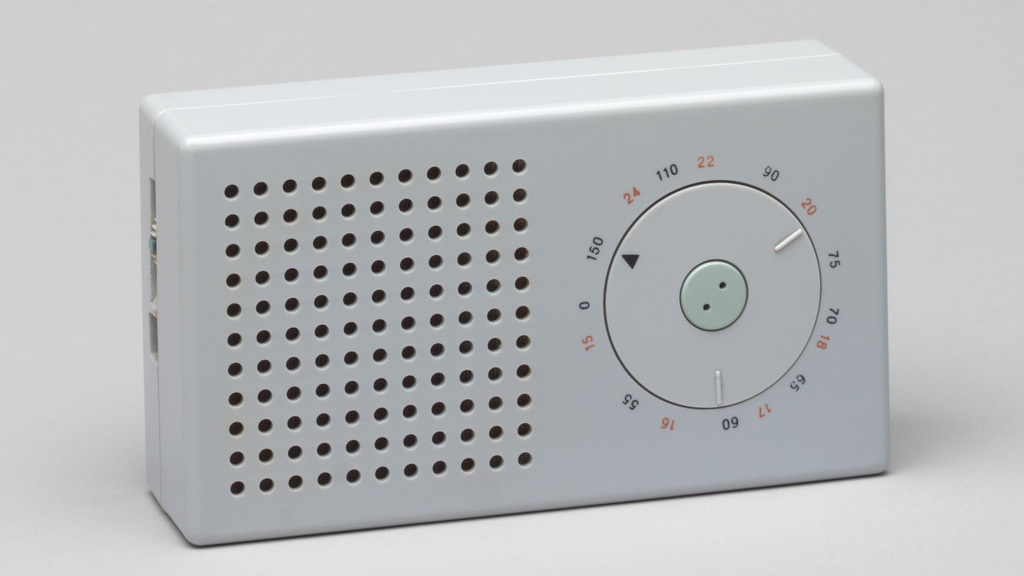
Braun T3, designed by Dieter Rams and Hans Gugelot, 1958. Image courtesy of MoMA
Designed by Dieter Rams and Ulm School designer Hans Gugelot in 1958, it is an object that has become synonymous with Braun: the white rectangular body, circular tuning dial, perforated speaker grille and extraordinary restraint.
And yet the Braun logo is on the back.
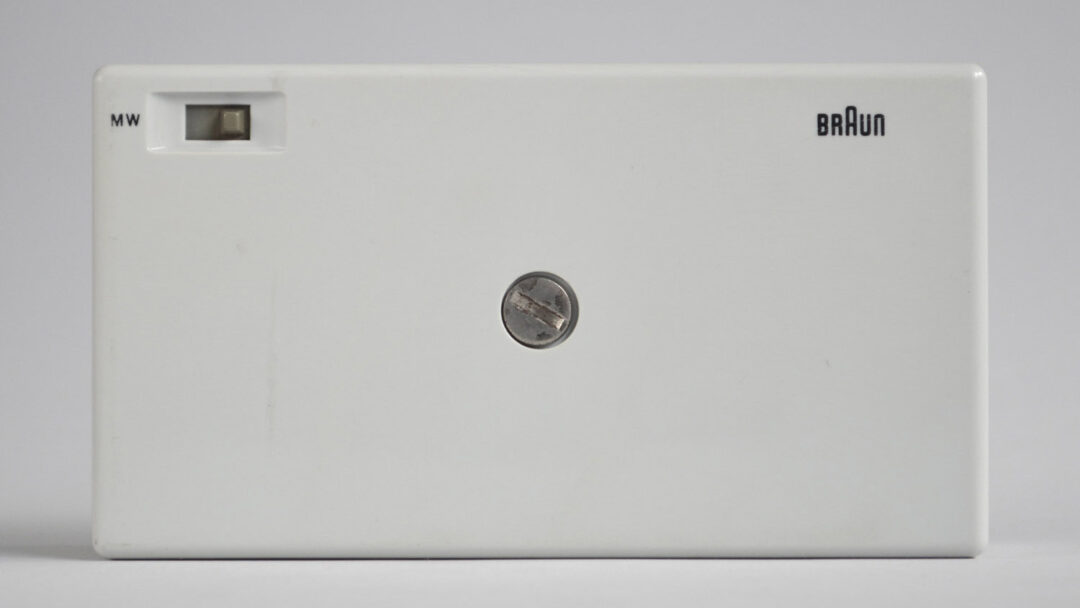
The back of the Braun T3. The logo was never the loudest part.
Rams had little interest in turning the objects he designed into advertisements for the company that made them. He disliked branding that shouted for attention. If the product was recognizably Braun in its proportions, materials, controls, typography and behaviour, making the logo enormous wasn’t adding much.
That confidence feels particularly refreshing in an era when the first request in a review can still be to make the logo bigger. It also makes what happened later at Braun more interesting.
Rams spent more than three decades shaping one of the most influential bodies of industrial design ever produced. He became Braun’s Head of Design in 1961 and remained in the role until 1995. His work entered museums, influenced generations of designers and eventually became an obvious reference point for the consumer technology that followed.
Toward the end of his time at Braun, however, Rams described growing disagreements with management. Marketing wanted more frequent redesigns. Products needed to appear new. Branding became more conspicuous. The philosophy that had allowed products to evolve slowly was coming into conflict with the commercial desire to continually give the market something different.
It’s tempting to tell this as a simple story about a great designer leaving and a company losing its way, but the real story is more useful than that.
Braun had spent decades building an organization capable of turning exceptional design judgment into a competitive advantage. Its later history shows how difficult that advantage is to preserve once the organization begins changing how much authority that judgment receives, and how easily the reasoning behind great products can disappear even while their visual language survives.
That problem should feel very familiar to anyone designing products today.
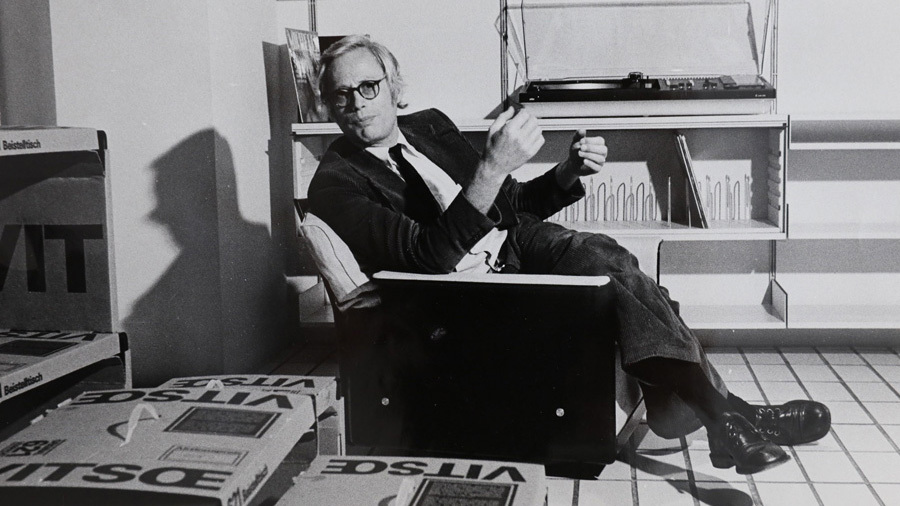
Before Dieter Rams was Dieter Rams
Looking backward makes Rams’s judgment seem almost self-evident.
His work is collected by museums. His ten principles for good design are taught to designers around the world. Jony Ive has spoken openly about his admiration for him. Entire generations of consumer electronics carry traces of the design language Rams helped establish at Braun.
Put Rams on one side of an argument about product design today and an executive asking him to make the logo bigger on the other, and history has already decided who won.
Braun didn’t have that luxury. Organizations don’t experience generational talent historically. They experience it in meetings.
Rams wasn’t sitting across the table from colleagues with a retrospective at the Museum of Modern Art behind him. He was the person responsible for design, arguing his position alongside people responsible for marketing, engineering, manufacturing and the commercial performance of the company.
And he wasn’t doing it alone. The mythology surrounding great design has a habit of compressing organizations into individuals. Braun becomes Dieter Rams in much the same way that Apple becomes Jony Ive. It makes the history easier to tell, but it obscures much of what made the work possible.
Braun’s design culture was already developing before Rams led it. The company worked closely with the Ulm School of Design. Fritz Eichler helped establish its design direction. Hans Gugelot co-designed the SK4 radio-phonograph with Rams. Wolfgang Schmittel shaped important parts of Braun’s visual identity. Designers including Gerd A. Müller and Dietrich Lubs contributed products that now sit comfortably inside what we think of as the Braun language.
What Braun built was larger than any one of them. It created an environment in which a group of remarkably talented people could make products according to a consistent set of beliefs, and where those beliefs could survive from one product to the next.
Hiring Dieter Rams was valuable. Building a company in which Dieter Rams could happen was far more valuable.
What Braun was actually protecting
It is easy to misunderstand Rams because his work photographs so beautifully.
Put a Braun radio on a white background and his philosophy starts looking like an aesthetic recipe: reduce the number of controls, remove decoration, use neutral colours, leave some space around things.
Minimalism is easy to imitate because surfaces are easy to copy. The harder part is understanding the decisions underneath them.
Consider the Braun KM3.

Braun KM3, designed by Gerd A. Müller, 1957.
The kitchen machine was designed by Gerd A. Müller and introduced in 1957. Its fundamental design survived for decades with relatively modest changes. Rams later used products like the KM3 when explaining Braun’s earlier approach: a successful object wasn’t automatically redesigned simply because enough time had passed. New technology, functionality or manufacturing possibilities could justify change. The calendar alone could not.
That requires a very different relationship with product development than the one many companies have today.
Braun products evolved as families. Controls appeared in familiar places. Typography, colour and proportion created relationships between objects performing completely different functions. A customer who understood one product could carry some of that understanding into another. Products weren’t treated as isolated opportunities to invent another visual language; previous decisions became a foundation for the next ones.
Consistency in that environment wasn’t merely aesthetic. It represented accumulated judgment.
Rams’s famous phrase, “less, but better,” is usually interpreted visually. But its more consequential meaning may have been organizational.
Less, but better isn’t a visual style. It’s governance.
It requires someone to ask whether a proposed change actually improves the product, and an organization willing to accept that the answer might be no.
That becomes difficult because businesses have perfectly legitimate reasons to want change. Retailers want something new on shelves. Marketing needs something new to communicate. Competitors launch products that make last year’s offering appear old. New executives arrive wanting to demonstrate progress. Product teams have roadmaps to fill.
None of those incentives are irrational. Together, however, they create an environment in which leaving something alone can become surprisingly difficult.
One of Braun’s achievements was making restraint an acceptable outcome. A product didn’t need to look different simply because another year had passed.

When novelty becomes a requirement
Gillette acquired Braun in 1967, while Rams was still producing some of his most celebrated work. For nearly three decades, corporate ownership and extraordinary design coexisted.
That makes the later history more complicated than a familiar story about corporate ownership crushing creativity. The ownership structure was already there.
What Rams described was a gradual change in the kind of pressure design faced.
In an interview published by the Dieter Rams Foundation, he recalled that during the 1990s Gillette’s American marketing organization gained influence at Braun and pushed for continual redesign. Rams contrasted that approach with the philosophy Braun had previously followed: products should be redesigned when advances in technology, function or production gave the company a reason to improve them.
A company will always impose constraints on design, and it should. A product has to be manufacturable. It has to hit a price. It has to reach a market. Engineering and commercial realities exist, and Rams spent his career working within them.
The shift he described was subtler. Improving a product might require a new design; increasingly, needing a new design could become the starting requirement.
That inversion matters.
Once novelty becomes an input rather than an outcome, established decisions acquire a new burden of proof. The question quietly changes from “Why should we alter this?” to “Why are we still doing it this way?”
Sometimes that is exactly the question an organization needs to ask. No design principle deserves immortality simply because it worked before. Markets change. Technologies change. Behaviours change. Principles that cannot survive scrutiny eventually become dogma.
But there is a difference between scrutinizing an inherited decision and forgetting why it was made.
Rams retired from Braun in 1995. Peter Schneider, whom Rams had hired years earlier, succeeded him as Head of Design. Braun’s own account of the period describes an effort to break away from the tightly defined design style Rams had established.
From inside an organization, that impulse is understandable. Decades of consistency can begin to resemble stagnation. A design language that once felt disciplined can start to feel restrictive, and a new generation of leadership and designers naturally wants to leave its own mark.
Success can actually make this problem harder.
Later generations inherit the answers without necessarily inheriting the questions that produced them.
A restrained logo can begin to look timid once nobody remembers the argument for restraint. A familiar control layout can look conservative once the usability reasoning behind it is no longer discussed. A product that changes slowly can look neglected when the organization no longer remembers that slow evolution was deliberate.
The difficulty is knowing whether you’re removing a limitation or dismantling an advantage.
The seven-minute review
Anyone who has worked in product design has experienced a smaller version of this problem.
A team spends weeks or months understanding something. Researchers interview users. Designers explore alternatives. Engineers identify constraints. Product managers reconcile competing requirements. Analytics expose unexpected behaviour. Prototypes fail, edge cases appear and assumptions change.
Eventually, the work reaches a review and someone who hasn’t lived through that process sees it for seven minutes.
“Why don’t we move this over here?”
Sometimes they’re right. Fresh eyes are valuable precisely because they haven’t spent months becoming accustomed to the solution. Senior leaders may also possess context the product team doesn’t: a change in company strategy, an important commercial relationship, an impending market shift or a constraint that hasn’t yet reached the team.
Sometimes the suggestion was version three of twenty-seven, tested six weeks ago, and it failed.
The problem isn’t that senior people have opinions. They should. The harder question is what happens to those opinions after they’re expressed.
Healthy organizations need broad opinion rights. Designers should be challenged by engineers. Executives should be challenged by researchers. Product managers should be challenged by customer support. Someone completely outside the problem may notice the assumption everyone closest to it has stopped seeing.
Decision rights are different.
Every opinion does not become equally informed because it entered the same meeting. A CEO may understand the company better than anyone in the room without understanding an interaction better than the designer who has spent three months studying it. That designer may understand the interaction intimately while knowing almost nothing about the commercial constraint driving the CEO’s concern.
Mature organizations need ways to hold both realities at once.
This is particularly important when a company hires highly capable specialists. Their expertise only becomes an organizational advantage when the company can recognize where their judgment is strongest and create enough room for it to matter. Otherwise, a business can acquire expertise, put it into meetings, and continue making decisions almost exactly as it would have without it.
Leadership still owns outcomes. But ownership of an outcome does not require personally authoring every decision that produces it.
Knowing when another person’s judgment deserves room to operate is part of leadership too.
Your Figma library won’t save you
Product organizations have become very good at preserving the visible outputs of design decisions.
We have components, tokens, variables, pattern libraries, contribution models, documentation and governance processes. A mature design system can encode thousands of decisions and distribute them across an organization.
Braun was doing a physical version of this decades before Figma existed. Its products shared proportions, typography, colours, controls and interaction conventions. Objects belonging to completely different categories still appeared to come from the same intellectual system.
But there is a limitation to what any design system can preserve. Recording a decision is relatively easy; preserving the reasoning that produced it is much harder.
Imagine inheriting a mature product without the people who made it.
Someone asks why a particular area contains so much empty space.
Nobody knows.
Tighten it.
Why doesn’t this surface contain a promotional module?
Nobody knows.
Add one.
Why is the brand so understated here?
Nobody knows.
Make it more prominent.
Why does this workflow require fewer steps than the new business requirement seems to demand?
Nobody knows.
Add the steps.
Every decision can be completely reasonable in isolation, which is precisely what makes institutional erosion difficult to notice.
There is rarely a meeting where everyone agrees to destroy the design language. Nobody opens a Jira ticket called “Remove everything that makes this product distinctive.” A series of locally rational decisions slowly erodes the whole, while the component library may remain immaculate throughout.
Better documentation helps, but it doesn’t solve the deeper problem.
Suppose the original team documented everything perfectly. The generous spacing exists because it establishes hierarchy. The promotional module was excluded to protect task completion. The brand is understated because recognition comes from the product language. The workflow is short because research repeatedly showed the cost of interruption.
Five years later, the organization encounters a situation the documentation never anticipated.
Now someone has to interpret the principle.
Does protecting task completion mean promotional content can never appear? Does preserving a recognizable interaction mean the interface can never adapt to a new device? Is the old research still relevant to today’s users? When does consistency become inertia?
No component library can answer those questions. Neither can a perfectly written design-system page.
Rules can preserve previous judgment. They cannot exercise new judgment.
That requires people who understand the principles deeply enough to adapt them without casually dissolving them. It requires institutional memory, but also taste, experience and the confidence to distinguish the spirit of a system from its historical implementation.
This is where many design systems quietly become museums.
The artifacts survive. The organization can reproduce yesterday’s decisions with extraordinary precision. What becomes harder is making tomorrow’s decisions for the same reasons.
Someone else was studying the old Braun
There is an odd historical irony in what happened next.
As Braun moved away from aspects of the tightly controlled design language associated with Rams, another technology company was becoming deeply interested in precisely those ideas.
Apple.
The visual comparisons have been made so often that they’ve almost become design trivia: Braun’s T3 radio beside an iPod, the ET66 calculator beside Apple’s Calculator app, Braun audio equipment beside later Apple hardware.
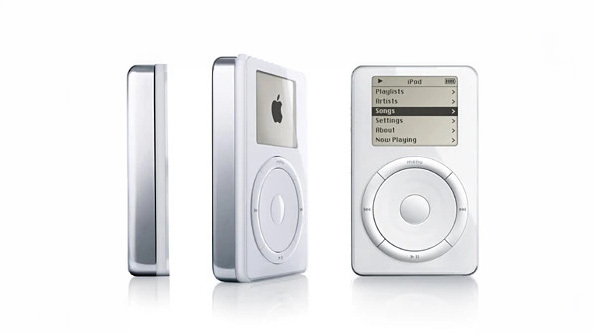
The first-generation iPod, 2001. The resemblance is difficult to miss.
Whether Apple copied Braun matters less than what both companies reveal about how organizations see their own constraints. Jony Ive openly admired Rams, and Rams himself spoke positively about Apple. Principles that could appear restrictive inside an organization that had lived with them for decades looked remarkably fertile to designers encountering them elsewhere.
An organization experiences its own constraints every day. Employees see the same typography, interaction patterns, product architecture, principles and rules. Familiarity can eventually make distinctiveness feel ordinary.
From outside, the same thing can look like intellectual property.
Apple didn’t need to reproduce Braun products for Braun’s history to matter. The broader lesson was already there: complex technology could feel understandable. Objects could be sophisticated without appearing intimidating. Restraint could create identity rather than erase it.
Meanwhile, Braun faced real commercial pressures that shouldn’t be rewritten as a morality tale about design. The electric-shaver market changed. Competition intensified. Germany and Japan experienced economic weakness. Manufacturing economics shifted. Gillette struggled with broader business problems. Gillette was eventually acquired by Procter & Gamble, and parts of Braun’s business were later sold or licensed to other companies.
There is no credible equation where Dieter Rams retires in 1995 and Braun’s business declines because the radios became less beautiful. Corporate history isn’t that convenient.
What we can trace is narrower: the remarkably coherent design institution associated with Braun’s most influential period became harder to identify as the company evolved, ownership changed and categories fragmented. Products could continue carrying the Braun name even as the conditions that had produced the Braun we remember became harder to preserve.
There is a useful warning in that distinction. A design legacy is something a company inherits. A design culture is something it has to keep doing.
You won’t know they’re Dieter Rams yet
Looking backward makes organizational judgment seem much easier than it is.
Of course you listen to Dieter Rams. He’s Dieter Rams.
We have museums, books, documentaries, retrospectives and decades of hindsight telling us that his judgment was exceptionally good. The people sitting across from him in a conference room didn’t have any of that.
The same problem exists inside organizations now.
The person pushing back on a change might be protecting an important principle, or they might be stubborn. The designer refusing to follow the market might see something everyone else has missed, or simply be attached to their own work. The engineer insisting on an architectural constraint might be preventing a problem that won’t become visible for three years, or they might be overengineering.
Experience doesn’t eliminate these ambiguities. It makes judging them part of leadership.
The challenge is distinguishing conviction from ego, accumulated judgment from resistance to change, and expertise from territorialism. There is no organizational framework capable of making those distinctions automatically, and documentation can only take us so far. Eventually somebody has to make a judgment about someone else’s judgment.
Hierarchy is an attractive shortcut because it resolves that ambiguity quickly.
It can also be expensive.
A company can spend enormous amounts of money finding exceptional designers, engineers, researchers, strategists and operators, then slowly teach them that their expertise matters only until someone sufficiently senior disagrees.
The company hasn’t necessarily lost its talent when that happens. The people may still be sitting in exactly the same chairs. What becomes inaccessible is some of the judgment it hired them for.
That may be the harder lesson in Braun’s history.
Great design can survive a new owner. It can survive commercial constraints. It can survive changing technologies and generations of products. What is much harder to preserve is the shared understanding of why certain decisions were worth defending in the first place.
Today, we know Dieter Rams was Dieter Rams.
Someone in your organization may be protecting the thing everyone else will eventually realize made the product great.
Prompting isn’t magic—it’s briefing
💻 A product designer’s guide to better AI outputs. If you want ChatGPT to deliver actual design
UX for Power, Not Politeness
What Music Software’s Intentional Chaos Teaches Product Designers Figma? Cute. Tesla’s dash? A b

It’s an Input, Not an Instruction
What a bird in the hand taught me about territorial design thinking Most designers have been sent a


